Subscribing to a VPN can enhance your online privacy and security. But choosing the right VPN service can be tricky.
They all seem to offer the same plethora of features and it can be difficult to see how one VPN provider differs from another.
In this post, we put NordVPN and ProtonVPN (now called Proton VPN) head to head to see which one comes out on top.
NordVPN
ProtonVPN

| Name | NordVPN | ProtonVPN |
|---|---|---|
| Rating | 8.5/10 | 9.0/10 |
| User Friendliness Score | 9 | 9 |
| General features | ||
| Free plan | No | Yes |
| Simultaneous Connections | 10 | 1 (free), 10 (VPN Plus) |
| Countries | Over 100 | Over 100 |
| Allows torrenting / P2P | Yes | Yes (paid plans) |
| Streaming | ||
| Netflix | Yes | Yes (paid plans) |
| Security | ||
| Supports TOR | Yes | Yes |
| Split Tunneling | Yes | Yes |
| Unlimited bandwidth | Yes | Yes |
| Refund Period | 30 Days | 30 Days |
| Desktop Operating Software | Windows, MacOS, Linux | Windows, MacOS, Linux |
| Mobile Apps | iOS, Android | iOS, Android |
| VPN Protocols | NordLynx (WireGuard), OpenVPN, IKEv2 | WireGuard, Stealth, OpenVPN, IKEv2 |
| Open-source apps | No | Yes |
| DNS Leak Protection | Yes | Yes |
| VPN Kill-switch | Yes | Yes |
| Malware/Ad Blocker | Yes (Threat Protection) | Yes (NetShield, paid plans) |
| Privacy | ||
| Logging Policy | No-logging Policy, audited | No-logging Policy, audited |
| Jurisdiction | Panama | Switzerland |
| Out of 14 eyes | Yes | Yes |
| Accepts Cryptocurrency | Yes | Yes |
| Speed (average, our 2020 test) | ||
| Avg. Download NY | Over a 60 Mbps Network (Download): 65.77 Mbps | Over a 100 Mbps Network (Download): 90.42 Mbps |
| Avg. Upload NY | Over a 30 Mbps Network (Upload): 22.89 Mbps | Over a 30 Mbps Network (Upload): 35.60 Mbps |
Can't choose between NordVPN or ProtonVPN?
Both NordVPN and Proton VPN are well-known in the commercial VPN industry. And they both have a strong feature set with regard to privacy and ease of use.
They both commit to a strong no-logging policy, and both have had it checked by outside auditors. They both use WireGuard, next to other secure protocols. They both provide native client apps, that include a kill switch, for all major operating systems. And they both unblock Netflix in many countries.
When we first compared them, in 2020, NordVPN won most rounds, largely because Proton didn’t support WireGuard yet and its plans were expensive and convoluted. Both points are history. Today, this is a very close one.
Let’s start.
1. Speed
Speed will always be important for VPN providers. People want the benefit of privacy, but they also want to get the bandwidth they’re paying for.
I performed speed tests over both networks in 2020. Let’s take a look at the results.
NordVPN
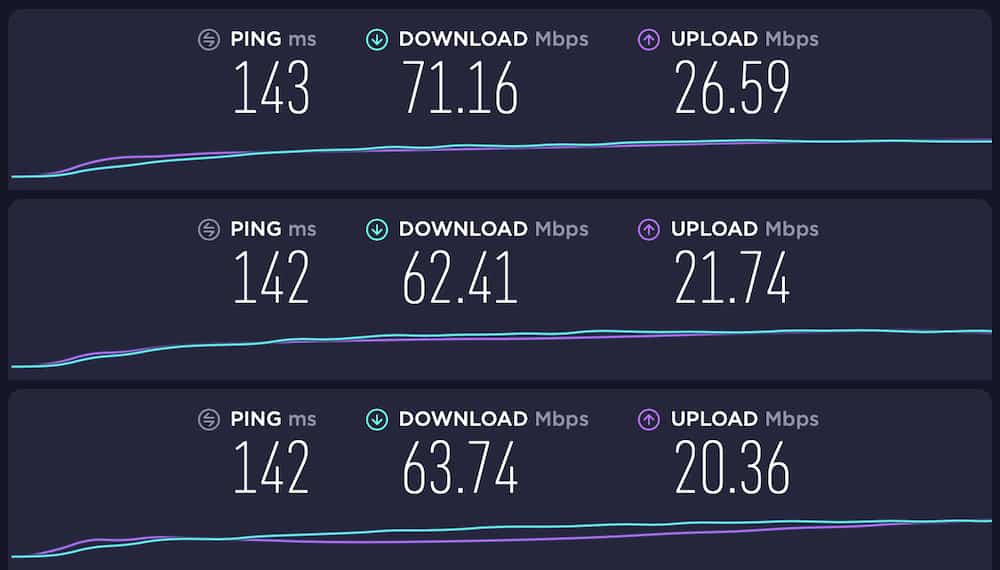
Tested on a 60Mbps (Download) and 30Mbps (Upload) network
Server: U.S.A., New York
Average Download Speed: 65.77Mbps
Average Upload Speed: 22.89Mbps
ProtonVPN

Tested on a 100Mbps (Download) and 30Mbps (Upload) network
Server: U.S.A., New York
Average Download Speed: 90.42Mbps
Average Upload Speed: 35.60Mbps
So what we want to see is the difference between the official ISP speed and the speed we’re getting over the VPN. And both of them perform extremely well on that front.
And though it’s likely due to network volatility, NordVPN’s download speed even goes beyond the rated speed I’m getting from my ISP. The same goes for ProtonVPN on upload.
Since then, both have moved to WireGuard-based connections by default (NordVPN calls its version NordLynx). WireGuard is fast and light, so both should do at least as well today, also on much faster connections than the ones I tested on.
Winner: Tie
This one is too close to call, in my opinion. Speed is not an issue for either NordVPN or Proton VPN. At these speeds, I don’t think anyone would notice the VPN’s overhead on their connection.
2. User-Friendliness
As VPNs go mainstream, user-friendliness and ease of use are quickly becoming some of the biggest differentiating factors between providers.
Both NordVPN and Proton VPN supply native client applications, that all include a kill switch, and that are compatible with many platforms: Windows, macOS, Linux, iOS, Android and Android TV. And they both, of course, provide unlimited bandwidth.
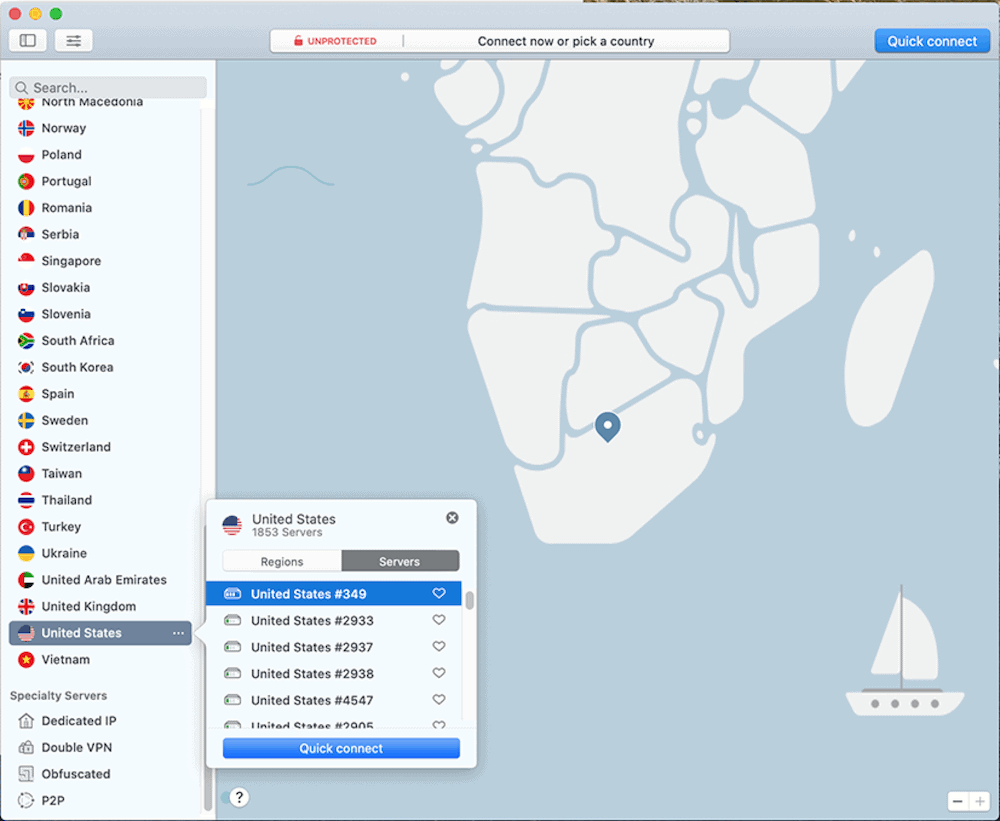
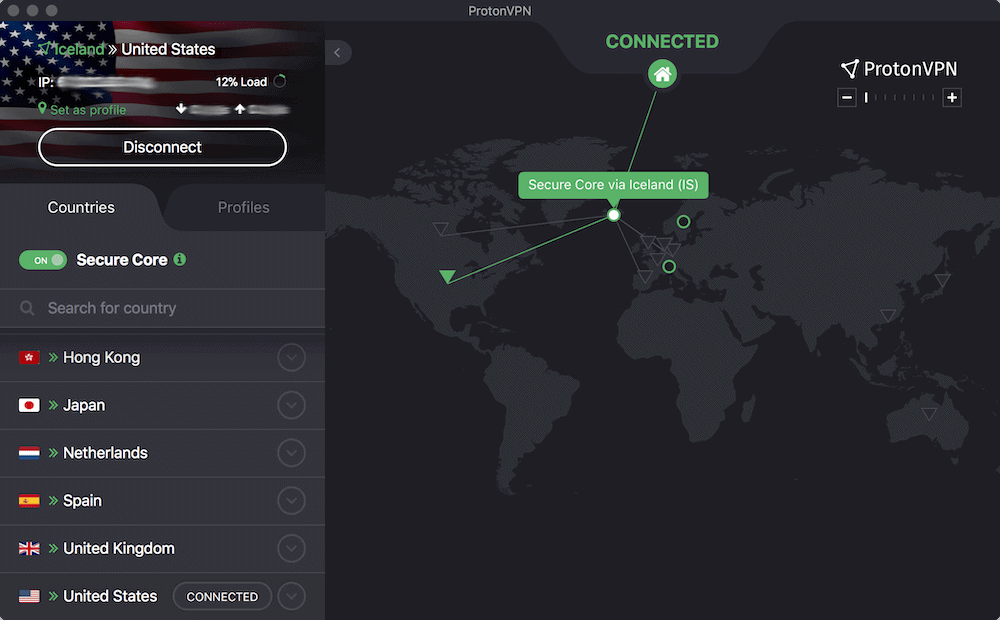
NordVPN also offers browser extensions for Chrome, Firefox and Edge. Proton’s apps are open source, so anyone can check what they do.
They both provide comprehensive customer support. I didn’t need to contact customer support from either provider.
As far as simultaneous connections are concerned, NordVPN allows up to 10 simultaneous connections on any plan.
Proton VPN’s free plan allows 1 device. Its paid VPN Plus plan, and the Proton Unlimited bundle, allow 10 devices, the same as NordVPN.
Winner: Tie
Both providers supply good client apps on the same platforms, with the same number of devices on a paid plan. NordVPN’s browser extensions are handy; Proton’s apps are open source. This one’s a tie.
3. Streaming
Streaming over a VPN has a few benefits, aside from a secure connection. It allows you to bypass geo-restrictions and to bypass ISP throttling issues.
And with the dominance of streaming services, this is quickly becoming a major feature for VPN providers.
And we also have certain streaming services, such as Netflix, banning VPNs from their platform. Hence circumventing the VPN ban has also been in growing demand from VPN users.
Both NordVPN and Proton VPN are streaming-friendly providers and they both claim to unblock Netflix. And both NordVPN and ProtonVPN provide a support document explaining how to unblock Netflix.
And they both deliver, as I wrote in my Netflix reviews of NordVPN and ProtonVPN.


In 2020, Proton only unblocked Netflix US. That’s no longer the case: like NordVPN, it now unblocks Netflix in many countries, as well as other streaming services. The one catch is that Proton only supports streaming on its paid plans, not on the free one.
Winner: Tie
Both NordVPN and Proton VPN unblock Netflix in many regions on a paid plan. Nothing to set them apart here.
4. Security & Encryption
Both NordVPN and Proton VPN only support secure VPN protocols.
NordVPN supports:
- NordLynx (NordVPN’s version of WireGuard)
- OpenVPN
- IKEv2
ProtonVPN supports:
- WireGuard
- Stealth (WireGuard hidden inside an ordinary-looking TLS connection, for networks and countries that block VPNs)
- OpenVPN
- IKEv2
Both providers support AES-256, which is the industry standard. AES-256 is considered a robust cipher with no known vulnerabilities. WireGuard uses different, more modern ciphers (such as ChaCha20) that are deemed very secure as well.
NordLynx adds a system on top of WireGuard so that NordVPN doesn’t have to keep your IP address on the server while you’re connected.
We’re happy to see that both providers only support secure protocols, unlike providers who still support weak and obsolete protocols, like L2TP/IPSec, or worse, PPTP.
Supporting weak protocols may put greener users at risk.
Winner: Tie
In 2020, NordVPN took this point because Proton was still working on WireGuard. Proton added it in 2021, and also has its own Stealth protocol for hostile networks. NordVPN offers obfuscated servers for the same purpose. On security, these two are now even.
5. Logs & Privacy
Both providers commit to a strong no-logging policy. Both say they don’t log your traffic, the sites you visit, your IP address or your connection times.
NordVPN is based in Panama, which has no data retention law for VPNs. Its no-logs policy has been checked by outside auditors several times: by PwC in 2018 and 2020, and by Deloitte in later years. Its servers run from RAM only, so nothing is stored on a disk.
NordVPN’s record isn’t spotless, though: in 2018, an attacker got into one of its servers, at a data center in Finland, through a remote management tool the data center hadn’t disclosed. NordVPN says no user data was taken, but it only told its users about it in 2019.
Proton VPN is based in Switzerland, which has strong privacy laws. Its no-logs policy has been audited by an outside firm (Securitum) repeatedly since 2022, and its apps are open source and have been audited too.
In 2020, Proton told TorrentFreak in its Which VPN Providers Really Take Anonymity Seriously in 2020? guide that it kept the timestamp of the last successful login, overwritten at every login, to protect accounts from password attacks. That timestamp says nothing about what you do on the VPN, and the audits since have confirmed that Proton keeps no activity or connection logs.
Winner: Tie
Both have clear policies, both have had them audited repeatedly, and both are based outside the 14 Eyes. Proton’s open-source apps are a plus; NordVPN’s RAM-only servers are too. It’s a tie.
6. Pricing
Let’s now turn to pricing. VPN prices change often, with frequent promotions, so we won’t list exact amounts that may be out of date by the time you read this. Here’s how NordVPN and Proton VPN compare:
NordVPN
NordVPN sells monthly, yearly and two-year subscriptions, each in several tiers. The basic tier is the VPN on its own; the higher tiers add things like the full Threat Protection malware scanner, a password manager and encrypted cloud storage. As with most VPNs, the longer the plan, the cheaper the price per month.
NordVPN has no free plan.
Payment Methods
- Credit Card
- Apple Pay
- Google Pay
- Cryptocurrencies
- Other local methods, depending on your country
ProtonVPN
Proton VPN has a free plan and paid plans:
- Free – 1 device, no data limit, no ads, but a limited choice of servers, and no streaming or P2P.
- VPN Plus – 10 devices, all servers, streaming, P2P, Secure Core and NetShield.
- Proton Unlimited – everything in VPN Plus, plus Proton’s other paid services: Proton Mail, Calendar, Drive and Pass.
The paid plans can be bought monthly, yearly or for two years, and the price per month goes down with the length of the term.
Payment Methods
- Credit card
- PayPal
- Bitcoin
- Cash
Both providers offer a 30-day money-back guarantee.
Winner: ProtonVPN
On the long plans, NordVPN’s basic tier and Proton’s VPN Plus cost about the same, with the same number of devices. Watch the renewal price with both: the first term is usually cheaper.
The difference is that Proton also offers a genuinely usable free plan, with no data limit and no ads. NordVPN has nothing like it. And we still commend Proton for accepting cash. Proton takes the point.
7. Torrenting
Torrenting is an area in which it will be difficult to set either of these VPN providers apart.
They both essentially offer the same thing here: dedicated P2P servers which are clearly marked within their respective apps and on their websites. On Proton, they are only available on the paid plans.
I tested both providers in my Torrenting reviews of NordVPN and ProtonVPN and I had no complaints on either network.

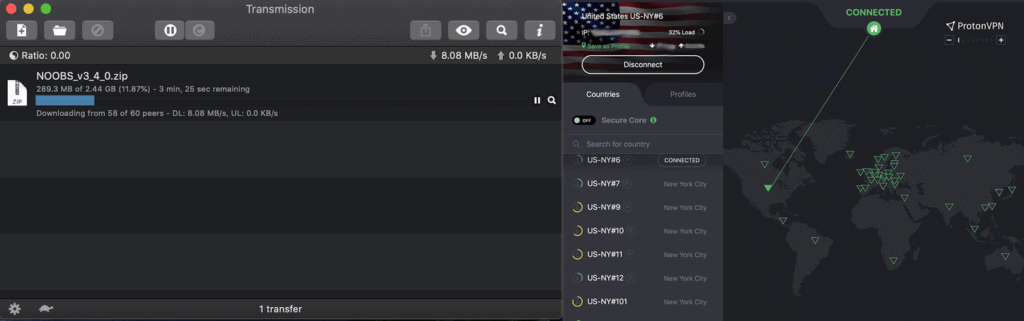
I was getting fast download speeds and no lag with either.
Proton has one extra that matters to regular torrent users: port forwarding on its P2P servers, which helps you connect to more peers and seed better. NordVPN doesn’t offer port forwarding.
Winner: ProtonVPN
Both work very well for torrenting. Proton takes the point for port forwarding, which NordVPN lacks.
8. Other Features
Let’s look at other aspects that differentiate these two providers.
- NordVPN provides Onion over VPN servers
- NordVPN offers Double VPN servers and dedicated IP addresses
- NordVPN’s Threat Protection blocks ads, trackers and malicious sites
- NordVPN was hacked in 2018
- Proton VPN supports Secure Core
- Proton VPN also has Tor servers and NetShield (an ad, tracker and malware blocker)
- Proton VPN comes from the same folks behind Proton Mail
Outstanding Features
NordVPN
- Onion Over VPN: NordVPN supports Tor Over VPN (called Onion Over VPN). What this feature does is route your VPN traffic over the Tor network, giving you an additional layer of security and anonymity. They achieve this by making certain servers available for specifically this purpose. So as soon as you connect to the VPN server, your connection will automatically be re-routed over the Tor network. Very cool.
- Threat Protection: NordVPN’s blocker stops ads, trackers and known malicious websites, and on the higher tiers it also scans the files you download for malware. It’s one of the more complete blockers built into a VPN.
ProtonVPN
- Secure Core: Secure Core is Proton VPN’s secure approach (hence the name) to double VPNs or multi-hop servers. When you enable Secure Core, then regardless of the server you choose to connect to, you will first connect to the Secure Core servers. These are hardened servers that Proton owns and runs, in Switzerland, Iceland and Sweden. From the Secure Core servers, your connection is bounced over to the VPN server you selected when you initiated the connection. This gives you enhanced security because if the VPN server you ultimately connected to is ever compromised, your connection will only lead back to the Secure Core servers and you won’t be exposed.
- Proton Mail: While it may seem strange to list an email service as a standout feature for a VPN provider, that’s nonetheless what I’m doing. Proton VPN was created by the same people who founded Proton Mail, one of the best-known encrypted email services. Proton Mail handles PGP encryption for you, which can otherwise be difficult to set up properly. It’s reassuring from a privacy & security perspective when a company with such a good reputation builds another privacy product. And if you want the whole set, the Proton Unlimited plan includes Proton Mail, Drive and Pass along with the VPN.
Winner: Tie
Both offer real extras. NordVPN has Onion Over VPN, Double VPN, dedicated IPs and a strong Threat Protection; Proton has Secure Core, Tor servers, NetShield and the rest of the Proton suite. Which matters more depends on you, so this is a tie.
Conclusion: NordVPN vs ProtonVPN
So who wins?
We had eight categories:
The winner in each category is awarded one point. And both providers get a point in the event of a tie.
So the breakdown is as follows:
- Speed – (Tie)
- User-Friendliness – (Tie)
- Streaming – (Tie)
- Security & Encryption – (Tie)
- Logs and Privacy – (Tie)
- Pricing – (ProtonVPN)
- Torrenting – (ProtonVPN)
- Other Features – (Tie)
So the result in our NordVPN Vs. ProtonVPN shootout comes to 8 points for Proton VPN and 6 points for NordVPN.
That’s a big change from 2020, when NordVPN won 7 to 3. NordVPN didn’t get worse; Proton caught up, by adding WireGuard, simplifying its plans and opening up Netflix far beyond the US.
Bottom line: These are two very good choices if you’re looking for a VPN provider. Proton edges it on value and openness; NordVPN has more extras.
NordVPN
Go With NordVPN if:
- You want a VPN provider located outside of the 14 Eyes, with RAM-only servers
- You want Double VPN or Onion Over VPN servers
- You want a dedicated IP address, or Threat Protection’s malware scanner
ProtonVPN
Go With ProtonVPN if:
- You want the enhanced security provided by their Secure Core servers
- You want open-source apps, or a free plan to start with
- You torrent a lot and want port forwarding, or you’d like Proton Mail in the same subscription
For more information on these two VPN providers, check out our NordVPN review and our ProtonVPN review.
Thanks for reading!