VPNs today are used for a wide variety of reasons. But their main reason for being is to safeguard your online privacy.
And on that front, not all VPNs are equal.
In this post, I review PureVPN’s service to see if I can recommend them.
I first reviewed PureVPN in 2020 and updated this review in October 2026. A lot has changed since then: PureVPN moved from Hong Kong to the British Virgin Islands in 2021, dropped most of its outdated protocols and hired an auditor to check its no-log claims.
The verdict: PureVPN is a solid choice on paper, with good features and a better privacy policy than it used to have – but the caveats still add up…
Short on time?
Here's what matters most.

Our score: 6.5/10
PureVPN ticks most boxes, and on the surface, they appear to be a good choice for the privacy-minded. But do a little digging and that initial optimism soon fades away.
There are worse choices on the market. But we can’t really recommend PureVPN.
Visit PureVPN (40% off)PureVPN Overview
| Name | PureVPN |
|---|---|
| Rating | 6.5/10 |
| User Friendliness Score | 7 |
| General features | |
| Price per month (cheapest) | From about $2.15 (2-year plan) |
| Simultaneous Connections | 10 |
| Servers | 6000+ |
| Countries | About 70 |
| Allows torrenting / P2P | Yes |
| Streaming | |
| Netflix | Yes |
| Hulu | Yes |
| Amazon Prime | Yes |
| Disney+ | Yes |
| Security | |
| Supports TOR | No |
| Split Tunneling | Yes |
| Router Support | Yes |
| Unlimited bandwidth | Yes |
| Refund Period | 31 Days |
| Free trial | No |
| Desktop Operating Software | Windows, MacOS, Linux |
| Mobile Apps | iOS, Android |
| Browser Extensions | Yes |
| VPN Protocols | WireGuard, OpenVPN, IKEv2 (PPTP, L2TP and SSTP on a few locations only) |
| Encryption | AES-256, ChaCha20 (WireGuard) |
| DNS Leak Protection | Yes |
| VPN Kill-switch | Yes |
| Rent/Own Infrastructure | Own |
| Hacked | No |
| Malware/Ad Blocker | Tracker & ad blocker (partial) |
| Privacy | |
| Logging Policy | No-logging Policy |
| Privacy Policy | Good, but we don't fully trust they conform to their policies. |
| Jurisdiction | British Virgin Islands (Hong Kong until 2021) |
| Out of 14 eyes | Yes |
| Warrant Canary | No |
| Accepts Cryptocurrency | Yes (via CoinGate) |
| Sign-up Information Required | Valid Email and name |
| Speed (average, 2020 test) | |
| Avg. Ping NY | 162.33 ms |
| Avg. Download NY | Over a 100 Mbps Network (Download): 75.22 Mbps |
| Avg. Upload NY | Over a 30 Mbps Network (Upload): 28.25 Mbps |
To give you a quick overview of their product, PureVPN has a strong feature set in regards to security as well as convenience: VPN kill switch, DNS protection, up to 10 simultaneous connections, split tunneling, a strict no-logging policy, and of course, strong protocols and ciphers.
Unfortunately, PureVPN harvested the personal information of its users and shared it with law enforcement, in the past. And it’s very difficult to recover from this kind of breach of trust – especially for a VPN provider. Its apps also still ship with a long list of third-party analytics services.
About PureVPN
PureVPN was founded in 2007, in Hong Kong, by staff members from Hong Kong-based GZ Systems. They started out with only two locations. In 2021, they moved their headquarters to the British Virgin Islands: the service is now run by GZ Systems Limited in Road Town, Tortola. Today, PureVPN lists over 6000 servers in about 70 countries.
Positives
- Industry-Standard Encryption
- Native Applications
- No-Logging Policy
- VPN Kill Switch
- Strong Ciphers
- No-log audits (Altius IT in 2018, later KPMG)
- Accepts cryptocurrency
Negatives
- 2017 Logging Controversy
- Native Apps use many third-party analytics scripts
- The current audit reports are not public
- No Multiple Server Hops
- No Tor Over VPN
What to Consider Before Buying a VPN Subscription?
As you probably already know, a serious VPN service will always have strong policies in place concerning:
- Privacy
- Security
- Anonymity
And I’ll make my usual points here, that a strict no-logging policy is more important than jurisdiction.
I feel this is particularly important in regard to PureVPN. When I first wrote this review in 2020, they were based in Hong Kong, and China had just imposed its National Security law on the territory. That was a real worry.
In 2021, PureVPN moved to the British Virgin Islands. The BVI have no law that forces a VPN provider to keep logs, and they are outside of the 14 Eyes alliance. So jurisdiction is no longer the main concern with PureVPN.
What matters more is whether a provider actually lives up to its no-logging policy. And on that front, PureVPN has a record: in 2017, it handed connection data to the FBI (more on that below).
Another important point is the payment methods accepted by the VPN.
Your money trail can come back to bite you. So a VPN provider that takes the privacy of its users to heart should accept cash and cryptocurrency.
PureVPN now accepts cryptocurrency (through CoinGate), but not cash.
Features & Benefits
Speed
I performed a quick speed test over PureVPN’s network, back in 2020. Speeds change as a provider adds servers and protocols, so treat these numbers as a snapshot.
The tests were performed using a 100Mbps download and 30Mbps upload connection. When testing over my ISP connection, I’m getting what I pay for: 100 down and 30 up.
The tests were run over a VPN server located in New York, which is geographically close to where I am physically located.
The speed test was performed three times, for added accuracy. And I take the average of the three tests as the final value.

Tested on a 100Mbps (Download) and 30Mbps (Upload) network
Server: U.S.A., New York
Average Download Speed: 75.22Mbps
Average Upload Speed: 28.25Mbps
So the first two tests are really very good. And on the second test, the speed hit is practically non-existent. On the third test, however, my speed is more than halved.
And it’s that third test that makes the average value seem worse than it actually is.
And this is likely due to network volatility and if I kept running my tests, the speed would very likely go back up.
This is very good performance.
On the upload side, I’m getting the same bandwidth as what is included in my ISP package. This is very good. And this kind of upload performance would be great for online gaming.
PureVPN performs well on speed, in my book. Good stuff.
Pricing
PureVPN’s prices have dropped a lot since 2020. It now sells three tiers: Standard (the VPN), Plus and Max (the VPN with extras such as a password manager).
The monthly plan costs 12.95 USD. The longer plans are much cheaper per month: in 2026, the 1-year and 2-year Standard plans worked out to roughly 2 to 4 USD per month, depending on the offer of the day.
Watch out for the renewal price: the low price only covers the first term, and the plan renews at a higher rate. Port forwarding and a dedicated IP address are paid add-ons.
PureVPN has offered a paid 7-day trial for 0.99 USD at times. Read the small print: such a trial turns into a full subscription unless you cancel it in time.
All subscriptions are backed by a 31-day money-back guarantee (yes, 31…). Payments in cryptocurrency are not refundable, though.
Streaming
PureVPN is streaming-friendly. And streaming over a VPN provides the following benefits:
- The security benefit of a fully encrypted connection
- Mitigating ISP bandwidth throttling
- Circumventing geo-restrictions
And Netflix?

Yes, we know, Netflix has been blocking VPNs from their service since 2016.
They are legally compelled to enforce the geo-restrictions content producers and publishers impose on their content.
Banning VPNs may be an extreme way to accomplish that goal, but it works.
Many VPN providers claim to bypass the ban. Some succeed, others do not.
PureVPN makes that claim and succeeded in my test. They have a dedicated page on their website, including a video tutorial, explaining how to unblock Netflix, and it couldn’t be easier: connect the VPN, log in to Netflix, stream.
I tested Netflix over PureVPN and it worked perfectly. Keep in mind that this is a cat-and-mouse game: which Netflix libraries work changes from month to month.

Torrenting / P2P

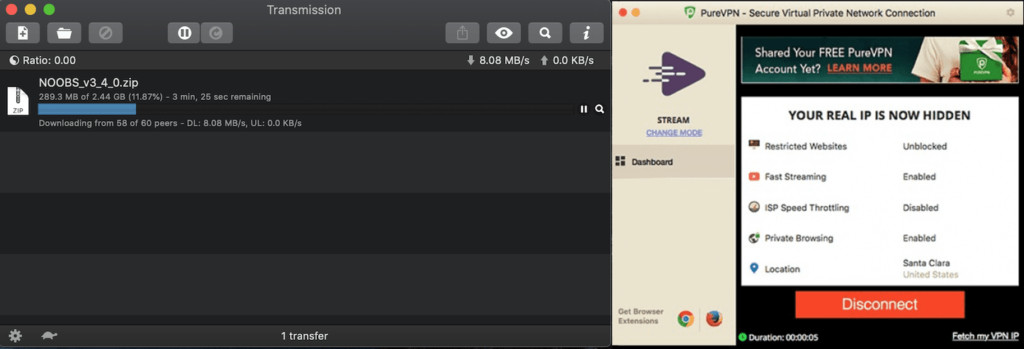
PureVPN allows P2P file sharing over their network, using dedicated P2P servers. The list of P2P-friendly servers is massive. When I tested, they only denied P2P access on servers in countries that are hostile to P2P: US, UK, Canada, Australia, etc.
Sadly, the P2P-friendly servers are not marked in PureVPN’s server list. But they are listed within the app, once you select the File Sharing category.
I tested P2P over PureVPN’s network, and it worked very well.
User-Friendliness
Supported Platforms

PureVPN supports more platforms than most. They support:
- macOS
- Windows
- Linux
- iOS
- Android
- Amazon FireStick
- Microsoft Surface
- Android TV
- Kodi
- Roku
- Boxee box
- Now TV Box
- Raspberry Pi
- Chromecast
- PlayStation
- Xbox
- Many routers
Massive coverage.
Native Apps

PureVPN provides native applications for the following platforms:
- Windows
- macOS
- Linux
- iOS
- Android
- Android TV
- Kodi
- Amazon Fire Stick
- Chrome & Firefox Browser Plugins
This coverage is again quite massive. Good show.
I found the native macOS app to be relatively easy to navigate and understand. What I liked less was the essentially empty security marketing and the PureVPN ad displayed in the app, as above.
There’s another thing I don’t like about their apps, which I’ll get into in the Privacy Policy section.
Number of Devices That Can Connect Simultaneously?
The number of devices that can simultaneously connect to PureVPN’s network used to be five, but they have since doubled this to ten simultaneous connections.
Good stuff.
The Number of VPN Servers Available?
In 2020, PureVPN advertised over 2000 servers in more than 140 countries. Many of those countries were virtual locations: servers elsewhere that give you an IP address from the country you picked.
Today, PureVPN lists over 6000 servers in about 70 countries, and nearly all of them are physical servers.
More than enough? I think so.
Do They Support Multiple Server Hops?
Bouncing your connection over multiple VPN servers before sending it off to the requested website adds another level of security to your connection. You are much harder to trace and identify in this scenario.
PureVPN does not support multiple server hops at this time.
Blocks Ads & Trackers?
PureVPN has since added a Tracker and Ad Blocker to its apps. That’s welcome, but independent tests found it blocks only part of the ads and trackers, so it’s no replacement for a good browser-based blocker.
Tor Over VPN Support?

Some VPN providers support a feature that bounces your traffic over the Tor network after the VPN connection is established. This enables a higher level of anonymity.
PureVPN does not support Tor Over VPN at this time.
Logs & Privacy
Let’s now take a look at PureVPN’s policies.
Have they ever spied on their users at the request of law enforcement?
As reported by The Register, in 2017, PureVPN confirmed to law enforcement that a man under suspicion of stalking connected to their service using two different originating IP addresses.
They then handed over those IP addresses as well as the IP addresses of the VPN servers used.
It’s essentially the same story we saw with IPVanish, in 2016, and which I wrote about in my IPVanish review.
And I’ll repeat what I wrote then, here.
Of course, criminals should be held accountable for their crimes. We all agree. But that’s not the point here. The point is that the individual in question could just as easily have been an activist, a dissident, a journalist, etc.
And if they were able to hand over that information, it means that they collected it, or had the technical means to collect it, to begin with.
That directly contradicts their privacy policy, as we’ll see.
Not good.
Would they warn users if/when compromised by law enforcement?
PureVPN has a precedent here. They didn’t do it before. I do not believe they would warn their users going forward.
How do they respond to DMCA notices?
I wasn’t able to find anything specific on this topic.
PureVPN disallows P2P file-sharing on sensitive servers (UK, US, Canada, Australia, etc.). If you stay away from those jurisdictions, you should be fine.
But I wouldn’t count on PureVPN having your back if the Copyright Police come knocking.
Logging Policy
PureVPN has a page dedicated to its no-logging policy on its website. At the top of that page, we find the following statement:
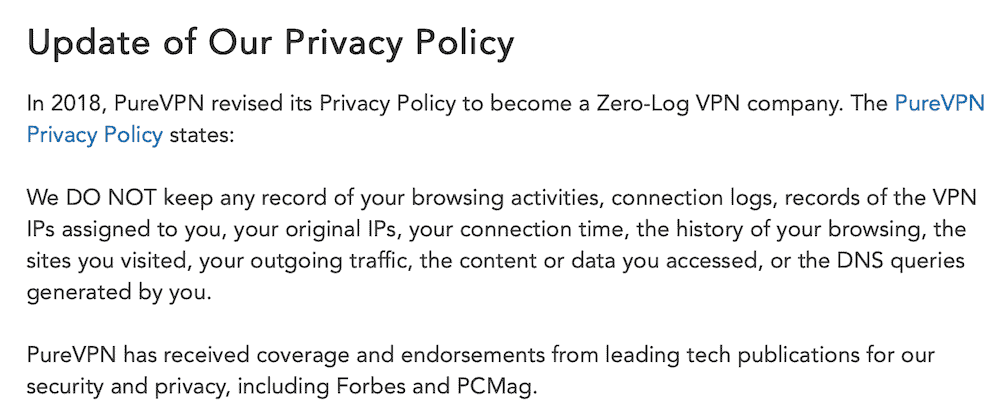
This is what we like to see, but it directly contradicts what they did in 2017.
You probably noticed that they start by stating that in 2018, they reviewed their policies to become a zero-log VPN company.
They even went as far as submitting themselves to a security audit by auditing firm Altius IT, which states:
“[We] did not find any evidence of system configurations and/or system/service log files that independently, or collectively, could lead to identifying a specific person and/or the person’s activity when using the PureVPN service.”
Later, PureVPN hired KPMG for an “always-on” no-log audit, which allows the auditor to inspect its systems without notice. That’s more than most VPN providers do. But the audit reports are not public, and PureVPN has since said it can no longer name the firm that audits it now.
Good stuff. But they have a trust deficit.
Privacy Policy
PureVPN’s privacy policy is actually quite good.
It’s clearly laid out. It’s clearly explained. It’s transparent and it isn’t written in legalese. This is all good stuff.
But again, PureVPN has a trust deficit, in my book…
Also, remember in the Native Apps section, when I wrote there was another thing I didn’t appreciate about PureVPN’s apps?
Well, as their privacy policy makes clear, their apps are loaded with analytics scripts. And I say “loaded” because the list is rather large. This screenshot is from 2020, but the October 2026 policy still names Google Analytics, Firebase, the Facebook Pixel, Mixpanel, New Relic, Sentry and Intercom:

So, kudos to PureVPN for being transparent about this.
But should a VPN provider – a company making its bread and butter selling privacy – be embedding usage tracking scripts from the world’s biggest privacy violators inside their apps?
No. They should not. A VPN provider should not be connecting to Google or Facebook or Firebase. Ever. Period.
Security and Encryption
Supported VPN Protocols
PureVPN’s apps support:
- WireGuard
- OpenVPN
- IKEv2/IPSec
These are the three protocols I recommend. In 2020, PureVPN also offered PPTP, L2TP/IPSec and SSTP, which are insecure or obsolete. In June 2021, PureVPN stopped supporting them on the majority of its locations, but it still keeps them on a few, at the request of users.
I prefer it when VPN providers do not support insecure protocols at all.
By supporting these, they may be helping the fringe advanced user on his rare edge case, but they are putting their less technical users at risk. So stick with WireGuard, OpenVPN or IKEv2.
Encryption Level & Supported Ciphers

PureVPN uses the AES-256 cipher for OpenVPN and IKEv2, and ChaCha20 for WireGuard (that’s part of the WireGuard protocol).
AES-256 is a very popular cipher. It has been around for a long time and has proven its effectiveness. AES-256 is very secure and contains no known vulnerabilities. ChaCha20 is a modern cipher that is just as secure and fast on devices without AES hardware support.
DNS Leak Protection

DNS Leak Protection is achieved by having the VPN provider run its own no-logging DNS servers from within the VPN tunnel.
A VPN provider that takes privacy seriously will default to this setup.
And PureVPN does just that. Your DNS queries are protected while on PureVPN.
VPN Kill Switch
A VPN Kill Switch stops traffic from flowing out onto the Internet if your VPN connection ever drops, for whatever reason.
This can be particularly useful in situations in which you need to leave your VPN connection unattended. In the event of a disconnect, you won’t need to worry.
All of PureVPN’s apps provide a VPN Kill Switch.
In Which Jurisdiction is the VPN Provider Based?
I say it every chance I get: a strong no-logging policy is more important than jurisdiction.
PureVPN is run by GZ Systems Limited, registered in the British Virgin Islands. Until 2021, it was based in Hong Kong, where China’s National Security Law of 2020 raised real questions about how safe user data would be.
The move to the BVI takes most of that worry away. The BVI have no law that forces a VPN provider to keep logs, and they are not part of the 14 Eyes alliance. They are a British Overseas Territory with their own laws and courts, though. Foreign authorities can still ask for data through a BVI court, but a provider that truly keeps no logs has nothing to hand over.
And that brings us back to PureVPN’s precedent. In 2017, the jurisdiction was not the problem: the logs were. So I’m cautious, due to their precedent, but more open than I was in 2020, thanks to the audits.
If you want more information on the 14 Eyes Alliance, check out our 5, 9 & 14 Eyes: What Does It All Mean For VPN Users? article.
Do They Have a Warrant Canary?

A warrant canary is a frequently published document, stating that a service provider has not been served a secret warrant or a gag order from law enforcement.
In the event that such a warrant and gag order is served to the service provider, they can take the warrant canary down, and by doing that silently communicate that they’ve been compromised.
Many VPN providers publish warrant canaries, but PureVPN does not, at the time of writing.
Do They Own or Rent Their Infrastructure?
Owning your infrastructure is preferable from a security standpoint, as it (technically) rules out third-party access.
Renting your infrastructure may be less secure, but it scales much better than having to set up bare metal servers in each country you wish to be present.
I was surprised to learn that, apparently, PureVPN owns its entire network of servers.
From their website, in 2020:
"PureVPN owns a self-managed global network of 2000+ Servers. Our server footprint covers 140+ Countries. As of now, PureVPN is the only VPN provider with this level of global presence.”
This is very impressive, if it still holds for today’s 6000+ servers. I couldn’t verify that independently.
Have They Ever Been Hacked?
From what I was able to find out, PureVPN has never been hacked.
What Information Is Collected at Signup?
PureVPN’s signup process is straightforward.
The only two pieces of information required are a valid email address and a valid payment method (which, for a credit card or PayPal, includes your name).
Cryptocurrency keeps your name out of it. Cash is not accepted, unfortunately.
Accepted Payment Methods
PureVPN accepts the following payment methods, among others:
- Credit card
- PayPal
- Apple Pay and Google Pay
- Cryptocurrency (Bitcoin, Ethereum and others, through CoinGate)
No cash. But cryptocurrency is a big improvement since my first review, when PureVPN only took credit cards and PayPal. Just note that crypto payments fall outside the money-back guarantee.
Standout Features
PureVPN owns its massive infrastructure
This is definitely a standout feature, if it holds. Few VPN providers claim to own such a large network of servers.
As I mentioned above, owning your own infrastructure is a great boon for security, as the access to the servers is completely under the control of the VPN provider. No third parties.
While this is great, however, PureVPN still has somewhat of a trust deficit, because of their 2017 logging controversy. The move away from Hong Kong and the audits help.
Time will tell whether that is enough.
Split Tunnelling
PureVPN also supports split tunnelling or selective routing.
Selective routing enables you to, for example, route your Internet traffic through the VPN, while keeping access to your local LAN network. This means that you could access any internal resources you have sitting on your LAN, like a file server.
Another use case would be to selectively route certain apps through the tunnel while routing other apps straight through your ISP connection.
There are many possibilities – split tunneling can be set up to accommodate almost any scenario.
Most serious VPN providers support split tunneling by now, so it is no longer rare. But it’s good to have.
What Others Are Saying
techradar.com

"PureVPN gives you a lot of functionality and is solid enough value, with an impressively wide variety of platforms supported. However, customer support is somewhat wobbly, and there are some worrying issues here which prevent this service from competing with the best VPN players out there.”
vpnmentor.com

"PureVPN is easy to use, but disappointing overall. Although it’s well priced, its app caused significant problems with my device. This provider is also tough to talk to directly and did not deliver the level of customer support I expect from premium VPNs. Their representative didn’t read my question properly and worse still, chose to send me a link to an article rather than answering.”
vpnranks.com

"To be honest, the last time I wrote on PureVPN review, I found their service to be absolutely terrible. However, they’ve certainly come a long way since then in 2020. PureVPN works with Netflix now, it doesn’t leak IPs anymore, their features work as advertised and they certainly revised their privacy policy for the good. If you compare PureVPN alternatives, let’s say PureVPN vs IPVanish, PureVPN is not only much safer, much cheaper, but it also offers far more servers as well. Not to mention PureVPN’s privacy features that are on par with other industry leaders.”
PureVPN Alternatives
Private Internet Access

Private Internet Access (PIA) is a U.S.-based VPN service. They put a strong focus on privacy and security while offering a large number of features.
They also have a strict and proven no-logging policy.
They have servers in 91 countries. They support many VPN protocols, including the obsolete and insecure PPTP protocol (unfortunately).
PIA is also one of the cheapest high-quality and secure VPN services out there.
- Based in the United States
- Strict no-logging policy
- Blocks ads & trackers
- SOCKS5 Proxy support included
- Servers in 91 countries
- One of the least expensive high-quality VPN Providers
NordVPN

NordVPN is an excellent VPN service, based in Panama. They offer a great mix of security, privacy, and convenience.
DNS leak protection, Threat Protection, strong encryption and a VPN kill switch have you covered on the security front.
A strict no-logging policy, a thoughtfully written Privacy Policy, Bitcoin payments, and a Panama-based jurisdiction have your back for privacy.
And dedicated P2P servers, native apps for every major (and not so major) platform, and up to 10 simultaneous connections (or more with a VPN router) make the service very user-friendly.
- Industry-Standard Encryption
- Native Applications
- Strict No-Logging Policy
- Ads & Tracker Blocker
- VPN Kill Switch
- Tor Over VPN
Surfshark
Surfshark is a VPN provider based in the Netherlands, which was founded in 2018.
They take a strong stance on user privacy and security, while still offering some very convenient features, such as background P2P routing.
Since 2022, Surfshark has been part of Nord Security, the company behind NordVPN.
Their sign-up process is minimalistic, in that it only requires a valid email address from you.
They only support IKEv2, OpenVPN and WireGuard. And while this may seem restrictive, we commend Surfshark for not weakening their users’ security by supporting insecure or obsolete VPN protocols.
Surfshark offers a very good service with a strong focus on privacy. And at around 2 USD per month on a long plan, it’s one of the least expensive, serious VPN services we’ve seen.
- Industry-Standard Encryption
- Native Applications
- Strict No-Logging Policy
- Ads & Tracker Blocker
- VPN Kill Switch
- Passed Security Audit in 2018
Conclusion
So while PureVPN has some positive elements, and has improved since 2020, overall, we still can’t recommend them. The jurisdiction is no longer the issue: since 2021, PureVPN is based in the British Virgin Islands, not Hong Kong. The main pain points are:
- The trust deficit, due to the 2017 logging controversy.
- The no-log audits are a good step, but the current reports are not public.
- All the tracking analytics found in their apps: Google, Facebook and others.
- Insecure protocols (PPTP, L2TP, SSTP) are still available on a few locations.
So, aside from casual streaming and perhaps protecting yourself while on the insecure WiFi of your local coffee shop (so long as you’re not doing anything mission-critical), I wouldn’t recommend signing up to PureVPN.
PureVPN is not recommended. But that could change in the future, for instance if they publish their audit reports and strip the trackers from their apps.
For more information on PureVPN, have a look at our Does PureVPN Work With Netflix? article.