So you want to block Facebook from tracking you across the Web?
Congratulations on joining the growing group of people trying to curb corporate surveillance.
But blocking Facebook isn’t as easy as you might think.
Facebook may be tracking your online activities in places you may not suspect. And you don’t even need a Facebook account for the social media giant to track your online activities.
In this article, we look at the settings Facebook (or rather Meta, as the company has been called since 2021) gives you, and at the ways you can block Facebook tracking in your browser, to help you gain a bit more control of your online privacy.
Facebook & Privacy
You’d have to be pretty naive to expect Facebook to respect their users' privacy.
Facebook’s entire business model hinges on their ability to analyze what you do on their massively successful social network, and well beyond it.
Your posts, likes, the pages you follow, the videos you watch and how long you look at them: it’s all collected and analyzed (by machines). That data is then used to build a detailed profile of you, so advertisers can target you with ads.
But the bottom line is that collecting data about you is their bottom line.
No need to dwell on the subject.
Along with “Water boils at 100 degrees Celsius”, it’s pretty much an established fact that Facebook and privacy don’t mix well.
With or Without Facebook?
I don’t use Facebook. I don’t have an account. For me, the privacy trade-off is just too big to sign up.
There are plenty of good reasons to have a Facebook account. And most of the people I know and respect do have a Facebook account.
But while they use Facebook, they are nonetheless uncomfortable with some of the company’s practices. And they would like to roll back some of the online tracking Facebook performs all over the Web.
I suspect most people reading this article fall into that category as well. After all, Facebook does have over 3 billion users.
This is a somewhat paradoxical situation. Knowingly using a privacy-invading service while being concerned with privacy. Again, there are plenty of good reasons for having a Facebook account.
But the point is this: Consider the advantages and the disadvantages of being on Facebook carefully. If you really are concerned about your privacy, think about deleting your account.
It’s a personal decision. And one that probably won’t be workable for many. But I could not write a “How To Block Facebook” article without making the case for getting off Facebook.
To delete your account, open Accounts Center (in Facebook’s settings), then go to Personal details, Account ownership and control, and Deactivation or deletion. Meta gives you 30 days to change your mind before it starts deleting your account, so don’t log back in during that time. Download a copy of your photos and posts first if you want to keep them.
Deleting your Facebook account is the most efficient way of limiting their surveillance. But as we’ll see, there’s still work to do even without an account.
So How Do You Block Facebook Tracking?
For those of you with a Facebook account, there are a few settings you can change to limit how Facebook uses what it learns about you.
They all live in Meta’s Accounts Center these days, which covers Facebook, Instagram and Messenger at once. The menus have been moved around a few times since 2020, and they still change now and then, but this is where to look.
So if you’re not ready to close your account, you should at the very least go through two parts of Accounts Center: your ad settings, and your activity off Meta technologies.
To Opt Out of Facebook Targeted Advertising:
- Log into your Facebook account.
- Click your profile picture, at the top right.
- Select Settings & privacy, then Settings.
- Open Accounts Center, select Ad preferences, then Ad settings.
You’ll find three settings worth changing on this page.
Activity information from ad partners
This is data about your activities on other websites and apps that advertisers and other partners send to Meta, for example through the “Meta Pixel” on a shop’s website. Meta uses it to target you with ads.
Choose to not have your ads made more relevant with this information. Be aware of what this setting does and doesn’t do: Meta still receives the data, it just won’t use it to pick the ads you see. To limit the data itself, see “Your activity off Meta technologies” below.
Ads shown outside of Meta
Meta also shows ads in other companies’ apps and websites, through its Audience Network. With this setting on, it uses what it knows about you from Facebook and Instagram to pick those ads.
You can go ahead and turn that off.
Ads about social interactions
Facebook can include what they call your social interactions, like liking a page, on ads they show other users.
You can choose who can see ads with your social interactions. Set this to “Only me” for better privacy.
Your Activity off Meta Technologies
This is the most important setting to restrict Facebook from tracking your online activities. It used to be called “Off-Facebook Activity”.
It shows the websites and apps that have sent Meta information about what you did there: visiting a shop, putting something in your basket, installing an app.
- In Accounts Center, select Your information and permissions.
- Select Your activity off Meta technologies.
- Choose Clear previous activity to disconnect the history Meta has collected so far from your account.
- Choose Manage future activity and disconnect future activity, so new activity from other businesses is no longer linked to your account.
Meta doesn’t stop receiving this data when you do this. But it no longer links it to your account, so it can’t use it to target you.
Living in the EU?
In the European Union, the EEA and Switzerland, Meta has to ask for your consent before it uses your data for personalised ads. That’s why it offers a choice there: keep using Facebook for free with ads based on your activity, pay for a subscription without ads, or choose less personalised ads, which use less of your data.
You can change that choice later in Accounts Center, under Ad preferences.
There's More...
The settings above only cover how Facebook uses your data. They don’t stop websites from sending it.
All the “Like” and “Share” buttons, embedded posts, Facebook logins and the Meta Pixel on a dizzying number of websites send data about your visit back to Facebook. This happens whether or not you have a Facebook account.
Yes, you read that last part right: whether or not you have an account.
So even if I convinced you to close your account a few paragraphs ago, you’re still not done if you want to block Facebook from tracking your online activities.
We have other tricks up our sleeve. Don't worry.
Your Browser is Your Friend
To block Facebook from tracking you off Facebook, your browser is the place to start.
Some browsers already block much of it by default. Firefox’s Enhanced Tracking Protection blocks known social media trackers, Facebook’s among them, and Safari and Brave also block third-party trackers out of the box. Firefox users can also add Mozilla’s Facebook Container extension, which keeps Facebook in its own isolated tab, so it can’t follow you around the rest of the Web.
For other browsers, or to go further, you’re going to need a browser plugin. You should be wary of installing browser plugins from unknown developers.
Browser plugins can usually access your traffic and other information from your browser. This can be particularly damning when installing a plugin meant to enhance your privacy.
Thankfully, the plugin I am recommending was developed by the Electronic Frontier Foundation (EFF). The EFF has a long and credible history of defending civil rights and liberties in the online space.
EFF's Privacy Badger
Privacy Badger is a browser plugin that stops ads and third-party elements from tracking your activities as you browse the web.
It’s available for Firefox, Chrome, Edge, and Opera. There’s also a version for Firefox on Android.
Privacy Badger is somewhat different from other ad-blocking browser plugins, in that it doesn’t rely on huge, hand-made block lists.
Most ad-blockers function by loading huge lists of known ad & tracker domains or IP addresses.
Privacy Badger uses algorithmic methods to determine if a Web element is tracking you. If it is, Privacy Badger automatically blocks it.
It does block well-known ads and trackers out of the box. And if you enable learning in its settings, it also learns as you browse the Internet.
Another advantage of Privacy Badger is its ability to load important elements in the site’s functionality (embedded maps, images or stylesheets, for example) while stripping out the tracking cookies and referrers.
Privacy Badger tends to break fewer sites than other blockers, because of this.

And Privacy Badger will, importantly, block Facebook widgets, “Share” and “Like” buttons and any ads posted by Facebook.
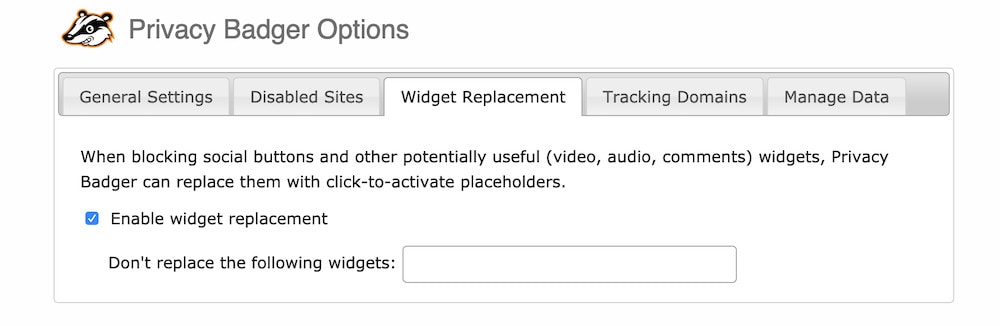
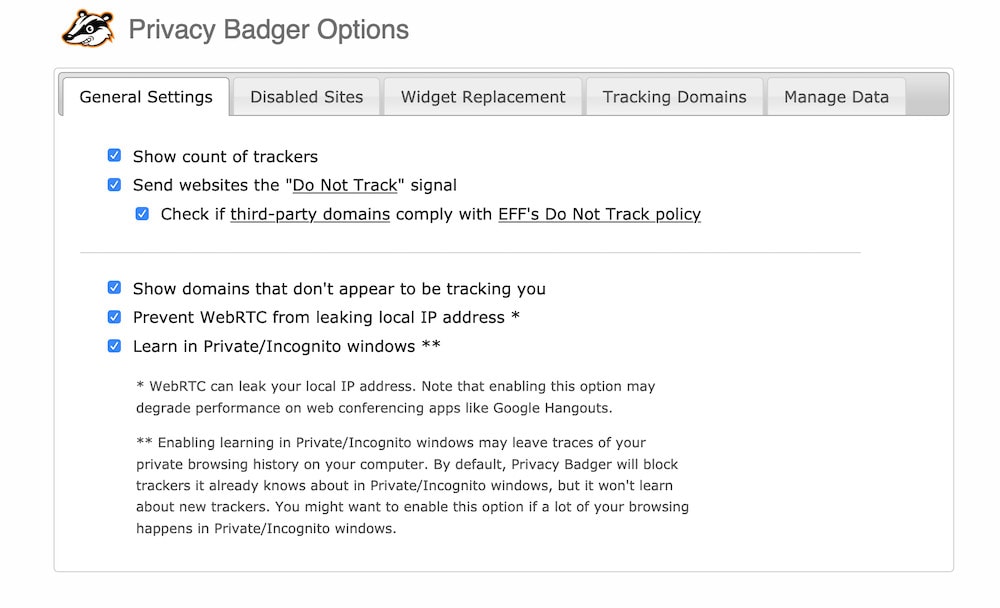
Privacy Badger is open source and is very easy to use. You don’t need to configure anything and it works out of the box. Though there are a few settings to dig into if you want.
One limit to keep in mind: more and more websites also send data to Meta from their own servers (Meta calls this the Conversions API), for example when you place an order. No browser plugin can see or block that. Only the Accounts Center settings above limit what Meta does with it.
One More Thing...
There is one other thing I can recommend in your efforts to thwart Facebook tracking: use a VPN.
When you use a VPN, your traffic appears to come from the IP address of the VPN server you’re connected to. This makes it much harder to deduce your location from your IP address, and to link your visits together by it.
But a VPN does nothing against cookies, the Meta Pixel or the Like buttons. And of course, if you’re logged into Facebook (or any site), your cover is blown. So use a VPN alongside the steps above, not instead of them.
So there you have it. There are quite a few steps involved in properly blocking Facebook from tracking you across the Web.
And they’re probably coming up with new ways as I write these lines.
But following these steps should keep most of their tracking out for now.